Categorieën
AI beleggen crypto NFA Podcast

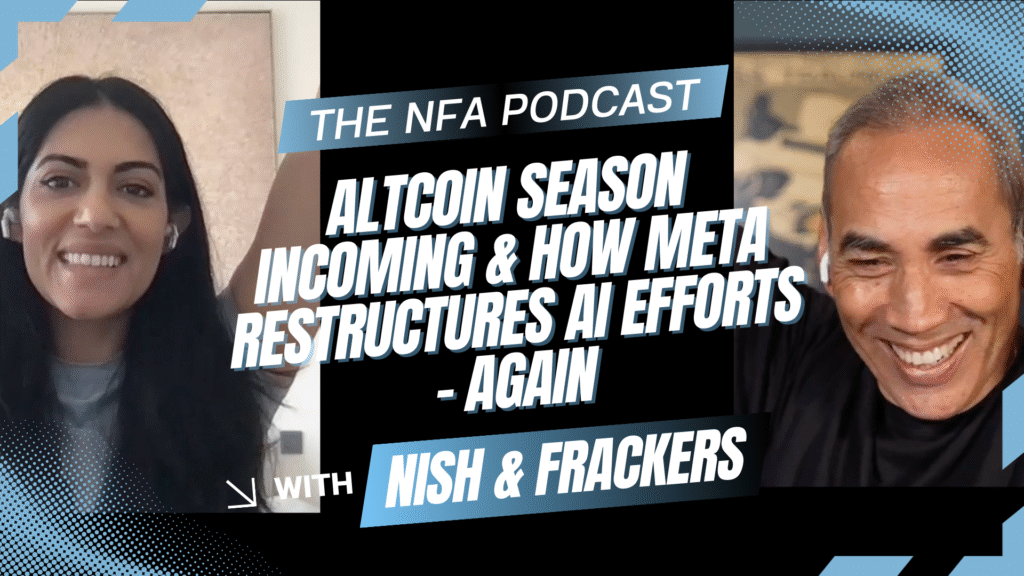
Altcoin season incoming & Meta restructures AI efforts – again

Dr. Nisheta Sachdev and Michiel Frackers are back from their summer vacation! No, not together and actually, they didn’t really have a vacation but they were swamped getting ready for the Tracer Initial Exchange Offering (IEO). More on that later, but for now, please enjoy episode 25 of the NFA Podcast where Nish and Frackers are thrilled about the imminent altcoin season and not so much about Mark Zuckerberg’s AI efforts…

Episode Summary

In this week’s NFA Podcast, Nish and Frackers cover the biggest tech and crypto stories shaping the markets. The discussion starts with macro forces driving crypto, including ETF inflows and interest rates, and how these overshadow internal crypto news. They unpack the classic cycle of Bitcoin ATH, Ethereum surge, and the coming of altcoin season, with dominance and fear and greed indices painting a mixed picture.

The hosts then dissect Meta’s fourth AI restructuring in six months. They critique Mark Zuckerberg’s buy-versus-build track record and ask whether Meta can produce AI products that are more than bolt-on features. They also highlight how consumer awareness and competition from platforms like Telegram and TikTok could challenge Meta’s dominance.

Other stories include Thailand allowing tourists to convert crypto into Thai baht to boost tourism, new hardware wallet recovery models to replace vulnerable seed phrases, and Blue Origin accepting crypto (but converting to USDT immediately). The US government’s $6M reward for information on Garantex, a Russian crypto exchange used for illicit activity, rounds out the news.

Finally, Nish and Michiel update listeners on their trading competition. Both portfolios are at $128 after a tough week, with Pudgy Penguins dragging Michiel down and meme coin A$$DAQ giving Nish some excitement. Solana, Broadcom, and Nvidia continue to show strength, proving that AI remains the strongest market driver.

Chapter List

· 00:00 Intro and episode overview

· 01:07 Macro vs crypto drivers

· 02:30 Altcoin season signals

· 04:02 Meta’s AI restructuring

· 05:11 Zuckerberg’s business model critique

· 07:00 Competition and consumer shifts

· 08:03 Thailand’s crypto tourism plan

· 09:16 Seed phrase security and new wallet models

· 10:54 Blue Origin accepts crypto for space flights

· 12:03 US reward for Garantex information

· 13:08 Market update and predictions

· 14:42 Altcoin season indicators and XRP signals

· 16:01 Fear and greed vs altcoin index

· 17:01 Trading competition update

· 18:03 Pudgy Penguins loss and AI stock strength

· 19:37 Meme coin A$$DAQ explained

Keywords

NFA Podcast, crypto, altcoin season, Bitcoin, Ethereum, XRP, BNB, AI, Meta, Mark Zuckerberg, Blue Origin, Jeff Bezos, Thailand crypto, tourism, seed phrases, Rider wallet, Pudgy Penguins, Solana, Nvidia, Broadcom, A$$DAQ, Garantex, crypto trading competition

Q&A Section

Q: What signals suggest altcoin season is starting?

A: Bitcoin and Ethereum have hit highs, typically followed by alts moving. Market dominance is shifting but indices show a transition phase.

Q: Why does Meta keep restructuring its AI division?

A: Zuckerberg has hired many researchers and acquired startups, but struggles to integrate them into a coherent business strategy.

Q: How is Thailand using crypto to boost tourism?

A: The government is allowing tourists to exchange crypto into Thai baht for 18 months as a pilot program.

Q: What’s the issue with seed phrases?

A: They remain a massive vulnerability. New models like Rider wallet use backup tags and multi-friend recovery.

Q: Is Blue Origin really accepting crypto?

A: Yes, but payments are converted immediately into USDT, raising questions about whether it’s genuine adoption or just PR.

Q: How did the trading competition go this week?

A: Both Nish and Michiel ended at $128 after losses across the board. Pudgy Penguins dragged Michiel’s portfolio down while A$$DAQ provided volatility for Nish.

The NFA Podcast is not financial advice.

Categorieën
AI beleggen crypto NFA Podcast technologie

Zuck’s $1 billion offer, CoinDCX Hack Inside Job and the Trading Rollercoaster

Nish killed me in the trading competition and could not stop gloating. Very poor winner.

Summary

News and macro discussion

The episode begins with a breakdown of the biggest story in tech: Mark Zuckerberg’s billion-dollar attempt to poach AI talent from his competitors: Human Machines Lab (Mira Murati), OpenAI and Anthropic. Nish and Frackers discuss how Zuckerberg’s superintelligence memo was inspired by, if not copied, from a character.ai memo from several years ago.

They reflect on how investors reward execution and momentum over originality or ethics. Other headlines include strong earnings by Apple and Microsoft and Amazon’s weak AWS numbers. In crypto, the CoinDCX hack is revealed to be an insider job involving $44 million in stolen assets, with on-chain sleuth ZachXBT helping expose it. The SEC’s “Project Crypto” is also discussed as a potential shift toward lighter regulation, although the lack of clarity left markets unmoved.

Market commentary and token picks

The middle segment covers how traditional markets and crypto reacted to this mix of strong earnings and regulatory uncertainty. Michiel points out that Ethereum still hasn’t broken its previous all-time high, which he sees as a signal of weakness despite increased buying from large entities like Ether Machine. Nish notes Tether’s reported $4.9 billion profit in Q2, noting that the figure is unaudited.

Trading challenge and portfolio results

In the final part of the episode, Nish and Michiel reveal the results of their increasingly competitive trading competition. Nish went full degen, flipping $30 into $240 on the AIR token before swapping into another meme coin called A$$ and ending at $135. He describes the emotional rollercoaster of near-instant profits followed by losses, calling it a full round-trip. Michiel took a more conservative approach, sticking with a mix of Nvidia, Broadcom and Bitcoin, and ended the week with a 17 percent gain since the start of the competition in early June. They compare strategies, risk tolerance and the psychology of trading in volatile markets. The segment ends with reflections on why most traders underperform even during bull markets, and a reminder by Nish that the challenge is about learning, not outperforming each other. Michiel is not buying it.

Chapter list

00:00 – Intro and episode preview

Overview of topics including Meta, CoinDCX hack, SEC regulation and the trading competition

01:30 – Zuckerberg’s $1B AI poaching strategy

Discussion on Meta offering $5 to $10 million per engineer and the ethics behind it

04:00 – Meta’s plagiarized superintelligence memo

Breakdown of Zuck memo’s similarities to character.ai and what it reveals about Meta culture

06:20 – Big Tech earnings and market reactions

Apple, Amazon and Microsoft results and how the market is responding

08:10 – Circle and Figma IPO chatter

Comments on IPO valuations and investor psychology

09:30 – CoinDCX hack and insider involvement

How $44 million was drained from an Indian exchange by insiders, and how ZachXBT helped trace it

12:00 – SEC’s “Project Crypto” grace period

Discussion on a possible regulatory shift and its unclear impact on token markets

14:30 – Ethereum’s weak price action despite good news

Why ETH still hasn’t hit a new ATH and what that means for investor confidence

17:00 – Tether’s $4.9B quarterly profit

Questions around how Tether generates its profit and whether it’s sustainable or lega

20:00 – Trading competition recap begins

Nish explains how he turned $30 into $240 and then back to $135 using AIR and A$$

23:00 – Michiel’s conservative portfolio performance

Breakdown of a 17 percent gain using Bitcoin and equities

25:00 – Risk and psychology in crypto investing

Reflections on emotional discipline and portfolio math

27:30 – Outro and next episode preview

Wrap-up, lessons learned and what’s coming next week

Links

Keywords and hashtags

Meta

Zuckerberg

AI

CoinDCX

CryptoHack

SEC

Ethereum

Tether

Altcoins

CryptoTrading

AIRtoken

ASStoken

Degen

NotFinancialAdvice

NFAPodcast

Key learnings

Meta’s AI strategy relies on money over innovation

Insider risk remains a major vulnerability for crypto exchanges

SEC guidance is ambiguous and may shift investor behavior

Ethereum underperformance raises questions about narrative strength

Degenerate trading can outperform but carries emotional cost

Portfolio math needs constant double-checking

Categorieën
beleggen crypto NFA Podcast

NISH GOT RUGGED*        

*In crypto, “getting rugged” (short for rug pulled) refers to a situation where a project’s creators or insiders suddenly and deliberately remove liquidity or value, leaving investors with worthless or severely devalued tokens.

Episode 19 of the NFA Podcast with Nish & Frackers is available here:

And of course on LinkedIn but in two parts, because for some odd reason LinkedIn does not allow videos longer than 15 minutes.

Here is part 1 and here is part 2 of Episode 19: Nish Got Rugged.

Summary

The NFA Podcast’s latest episode, hosted by Nisheta Sachdev and Michiel Frackers, covers recent developments in the crypto and tech world, while also featuring their ongoing trading competition. Nish and Michiel cover a whirlwind of crypto drama, political irony, and market twists.

They start with JP Morgan’s stablecoin launch, a $100M hack in Iran where the attackers burned the funds and BitGet’s partnership with UNICEF to fund girls’ education. Then they discuss Tron’s U.S. IPO following a possible presidential intervention and debate whether the SEC’s crypto probes are justified.

The episode heats up with a breakdown of Microsoft’s strategy to lock in OpenAI revenue while potentially blocking its IPO, and how Meta’s $100M AI sign-on bonuses reflect desperation in the AI arms race.

Nish shares a wild ride on PumpFun, turning $6 into $240 before getting rugged in a gamified token ecosystem that collapsed overnight.

The trading competition updates, personal AI cautionary tales, and a few sharp takes on egos (Trump, Zuck, and crypto bros alike) round out a packed episode.

Final score? Michiel’s steady portfolio beats Nish’s degen bets this week.

Links from this week’s stories

Keywords

NFA podcast, crypto news, market recap, JP Morgan stablecoin, Iran exchange hack, BitGet UNICEF partnership, SEC probe, AI in tech, market volatility, trading competition, Nvidia, Broadcom, Solana, PumpFun

Here are the key takeaways from the NFA S1E19 episode:

            1.        JP Morgan enters crypto (again)

Launching a stablecoin and possibly an ETF, JP Morgan signals deeper TradFi movement into blockchain though the market remains skeptical.

            2.        Iran’s biggest crypto exchange was hacked… and burned

Hackers allegedly discarded $100M in stolen crypto, not stealing it, raising questions about intent, ethics, and collateral damage.

            3.        Tron is going public in the U.S. after a Trump-era pardon

Justin Sun’s project makes a surprising comeback. The hosts question SEC consistency and the political influence behind enforcement.

            4.        BitGet & UNICEF announce a $10M CSR initiative

A rare positive headline: funding education for 300,000 girls globally. But the sudden appearance of an “extra” $100M raises eyebrows.

            5.        Meta’s AI push includes $100M signing bonuses

In its struggle to catch OpenAI, Meta acquires Scale AI but Nish and Michiel argue the money’s better spent elsewhere.

            6.        Microsoft’s real play: revenue, not equity

Satya Nadella blocks OpenAI’s IPO to protect Microsoft’s compute contract and 92B revenue clause, a smarter long-term win than owning 49%.

            7.        Using AI too early weakens your brain

An MIT study shows users who start with LLMs perform worse than those who write first. Nish shares a personal example from university.

            8.        Markets remain jittery but resilient

Despite global conflict signals and political noise, Bitcoin holds strong near 104K. Volatility persists, but dips are absorbed fast.

            9.        Nish gets rugged on PumpFun. Bigly.

Turning $6 into $240 trading gamified country tokens, then losing it all, she learns the old lesson: always take profits.

            10.      Trading comp: Risk vs. Restraint

Michiel’s steady strategy outperforms Nish’s high-volatility bets. They reflect on what makes a smart (or lucky) trader.

Chapters

00:00 – Crypto Chaos Incoming

Nish tees up the big stories: JP Morgan’s stablecoin, a major Middle East hack, Tron’s redemption arc and a wild trading week.

00:55 – JP Morgan Enters the Chat

Nish explains the stablecoin move, ETF rumors and why it signals a shift in TradFi’s crypto posture.

01:30 – Hack & Burn: Iran’s $100M Crypto Ghost

A pro-Israeli group hacks Iran’s biggest exchange and burns the tokens. Ethics, retaliation, and questions of civilian impact follow.

03:19 – BitGet x UNICEF: Finally, Some Good News

A rare feel-good headline: crypto helps educate 300,000 girls. But where did that extra $100M come from?

03:59 – Trump, Tron, and the Big D Energy

Tron goes public after a presidential pardon. What happened to the SEC probe? And why is Eric Trump an advisor?

05:09 – Corruption or Capitalism?

Michiel defends policy neutrality while Nish calls out open profiteering in every administration.

06:44 – AML, MetaMask & Who’s Responsible?

The SEC’s crackdown on crypto: fair regulation or policy overreach? Metamask, Binance, and double standards.

08:50 – Meta’s AI Faceplant

Meta tries to catch up in AI by buying Scale. But is a $100M sign-on bonus desperation or genius?

10:25 – WhatsApp AI: Cake, Confusion & Cringe

Why searching for “Nish” brings up Dutch cake recipes. A chaotic UX rant we all relate to.

11:12 – Microsoft v OpenAI: The SoftBank Ultimatum

Satya Nadella plays chess while the rest of tech plays checkers. The real reason Microsoft doesn’t want OpenAI to IPO.

13:30 – Who Needs 49% When You Own the Pipe?

Michiel explains how Microsoft gets $92B in revenue before any equity upside. It’s not about the shares, it’s about the compute business.

14:13 – Elon vs Zuck: The Ego Wars

Meta isn’t about data or AI, it’s about one-upping Musk. Zuckerberg’s Threads, rockets and rage.

15:28 – Short Man Syndrome & Global Instability

From Lord Farquad to Trump’s attention hunger: a comedic but sharp reflection on power, height and headlines.

16:31 – AI Is Making Us Dumb (Seriously)

An MIT study shows AI use reduces cognitive engagement. Nish shares a personal lesson on using AI in school.

18:15 – Market Check: Bombs, Bitcoin & BitVol

Ted Cruz “breaks” the news on U.S. war posture. Markets wobble. Anonymous drops a new video. BTC hangs around 104K.

20:43 – Bitcoin Up, Alts… Meh?

Predictions time. Bitcoin’s holding, alts are inconsistent, but both hosts expect an uptick.

21:09 – Trading Comp: Michiel Plays It Safe, Nish Goes Full Degen

Michiel’s portfolio edges up +2.69% with Nvidia and BTC. Meanwhile, Nish starts at $6 and hits $240 before getting rugged.

23:09 – Rugged After 40X: Nish’s PumpFun Epic

A gamified token with global domination vibes hits $4M cap… then vanishes. Telegram gone. Twitter gone. Devs gone.

25:40 – “Crypto Chad” vs The Exit Scam

How fake Twitter accounts, battle tokens and viral narratives fooled everyone. Could it have made top 100?

26:28 – Final Wallet Check: Michiel Wins This Round

Nish ends at $55, Michiel at $102.69. Lessons: take profits, don’t YOLO everything, and maybe skip PumpFun next week.

28:15 – Degens Gonna Degen

Nish embraces her degen roots. Michiel calls out hypocrisy: “You always tell me to sell half!” And yet…

28:59 – Next Week: Crypto Education & Viewer Questions

A light wrap-up. The team asks for token ideas and teases a segment on where to get real crypto education.

The NFA Podcast is Not Financial Information.

Categorieën
beleggen crypto NFA Podcast

Token2049 Revealed: Crypto Meets AI and Defense – NFA S1E14

Summary

This week’s NFA Podcast breaks down what actually happened at Token2049 in Dubai: more escorts than engineers, overcrowded venues, and 530 side events. Nish shares stories from the crypto trenches, Abu Dhabi’s investment into Binance via the Trump Family’s vehicle World Liberty Finance. We also talk about the scandal around Movement Labs, why Apple’s AI promise is still vaporware, how Zuvu is building the AI orchestration layer we need, and ex-OpenAI CTO Mira Murati’s new startup Thinking Machines Lab with full Andreessen Horowitz backing and her 100% control. Plus: AI chip stock moves, Eric Trump’s take on banks, and tokenized marble bunkers in the Italian mountains.

Chapters

00:00 – Intro and Token2049 Recap

09:50 – Trump Token Deal: Abu Dhabi, Liberty Finance, and Binance

13:43 – Movement Labs Scandal & Market Maker Manipulation

15:17 – Tech Earnings: Meta, Amazon, Apple

19:07 – AI Orchestration, Zuvu, and Apple’s Missed Promise

23:45 – Mira Murati’s New Startup with Full Control

27:31 – OpenAI’s Bold Revenue Claims & VC AI Hype

29:58 – Eric Trump Predicts Bank Extinction

31:20 – Stock Moves: From Nvidia to Broadcom

32:11 – Defense Tech and Tokenized Bunkers

Keywords

Movement $38 million dump, AI fragmentation, AI orchestration, AI subscriptions, AI tools integration, Abu Dhabi Binance investment, Amazon ads revenue, Andreessen Horowitz, Apple AI fail, Binance delisting, Broadcom stock, CoinDesk investigation, Dubai crypto event, Eric Trump, Eric Trump banks, Human Machines Lab, Kuwait bitcoin mining, Liberty stablecoin, Meta earnings, Mira Murati, Movement Labs, Nvidia, OpenAI $129B revenue claim, Palantir sell-off, Token2049, Trump token, World Liberty Finance, Zuvu, crypto conferences, defense tech, escorts at crypto events, founder control, marble bunkers Italy, market maker scandal, side events, tokenized bunkers

Categorieën
AI beleggen crypto NFT's technologie

Zesduizend miljard beurswaarde verdampt, ook crypto zwaar gedaald

Wereldwijde markten in vrije val door handelsoorlog

De Wall Street Journal blonk de afgelopen dagen uit in sobere, feitelijke berichtgeving maar kon niet voorkomen dat in het uitstekende samenvattende artikel over de gevolgen van de Trump-tarieven, toch totale paniek doorklonk. Een bloemlezing:

  • Er zijn momenteel veel verwarde, angstige en boze mensen,” aldus Steve Sosnick, hoofdstrateeg bij Interactive Brokers.
  • We zitten in een periode van zelf veroorzaakte braakneigingen, dat is de beste manier waarop ik kan samenvatten wat er deze week is gebeurd,” stelde Callie Cox, hoofdmarktstrateeg bij Ritholtz Wealth Management.
  • „Ik weet niet eens zeker of we ooit eerder zoiets gedaan hebben, de situatie escaleerde zo snel,” zei Adam Phillips, algemeen directeur bij EP Wealth Advisors.

Phillips had zijn klanten had gewaarschuwd voor een onrustig 2025, nadat de S&P 500 twee uitzonderlijk sterke jaren achter de rug had. Toch had niemand, inclusief hijzelf, deze uitverkoop zien aankomen. Toen nerveuze klanten deze week geruststelling nodig hadden, haastte hij zich om een video op te nemen. Zijn boodschap: “handel niet impulsief.”

Je vraagt je af tot wie Phillips zich richtte met zijn oproep, in de week dat een eiland waar alleen pinguins leven werd geconfronteerd met een handelstarief van tien procent wanneer de pinguins het in hun kruintjes halen om iets naar de Verenigde Staten te exporteren.

Zesduizend miljard dollar verdampt

Deze grafiek is niet ondersteboven; dit zijn de koersen van de Big Tech-aandelen sinds 1 januari 2025. Tot zover de ‘Trump-bump.’

Nadat China reageerde op de Amerikaanse heffingen beleefden internationale financiële markten deze week hun zwartste dagen sinds maart 2020. De Nasdaq en Dow Jones kelderden ruim 5 procent, wat leidde tot meer dan $6 biljoen (zesduizend miljard dollar) verlies aan marktwaarde binnen twee dagen.

Tesla trekt veel aandacht met een koersdaling van 41% dit jaar, maar chipmaker Broadcom blijft niet ver achter met een daling van 37%. De acht Big Tech-bedrijven Broadcom, Amazon, Tesla, Meta, Microsoft, Apple, Alphabet (Google) en Nvidia, samen BATMMAAN genoemd, verloren dit jaar gemiddeld 26% aan beurswaarde.

Door de plotselinge beursval zijn beursintroducties van bedrijven zoals kaartjesmarktplaats StubHub en fintechbedrijf Klarna uitgesteld. Internationaal verloor de Japanse Nikkei 225-index deze week negen procent, terwijl de Europese Stoxx Europe 600 met acht procent daalde. Beide indices noteerden hiermee hun grootste wekelijkse procentuele daling sinds maart 2020, toen wereldwijd het besef doorbrak dat de Covid-pandemie eerder jaren dan maanden zou duren.

Voorbeeld: de kostprijs van een iPhone 16

Bron: Wall Street Journal

Een goed voorbeeld van de gevolgen van de handelstarieven voor technologie-producten is de kostprijs van de iPhone 16. De productiekosten van Apple’s goudmijntje zouden door de nieuwe importheffingen stijgen van $580 naar ongeveer $850. Zonder prijsverhogingen zou Apple’s winstmarge sterk dalen, daar houden ze niet van in Cupertino, dus in dit scenario gaat de verkoopprijs van de iPhone 16 van $1.100 naar $1.700 dollar.

De recente maatregelen van president Trump zorgen voor grote aarzeling bij bedrijven om te investeren in nieuwe technologieën. Datacenterclub CoreWeave zal blij zijn dat het nog net op tijd de beursgang haalde, al is het voor bijna een kwart minder aandelen en tegen een veel lagere prijs dan verwacht. Het aandeel CRWV steeg de afgelopen week vrijwel als enige en liefst met 25%, waarschijnlijk door het bericht dat Google infrastructuur wil huren bij CoreWeave.

Et tu, crypto?

De tijd dat crypto een veilige haven was wanneer de ‘gewone economie’ in problemen kwam, is definitief voorbij. Crypto daalde dit jaar meer dan Big Tech.

Zelfs crypto kreeg een opdonder van de tarievenoorlog, al leek XRP nog na te genieten van het nieuws dat de SEC onder Trump afziet van de rechtzaak tegen XRP en het gelieerde bedrijf Ripple. Toch klinken er uit de ‘TradFi’ steeds meer serieuze geluiden die in lijn liggen met de gedachte van het hoofd research van Grayscale, die verwacht dat Bitcoin zal profiteren van een zwakkere dollar:

„Ik denk dat tarieven de dominante rol van de dollar zullen verzwakken en ruimte zullen creëren voor concurrenten, waaronder Bitcoin. Op korte termijn zijn de prijzen gedaald, maar de eerste maanden van de Trump-regering hebben mijn overtuiging versterkt dat Bitcoin op langere termijn een belangrijke mondiale monetaire rol zal spelen.”

Bitcoin is deflatoir, heeft een voorspelbaar aanbod en wordt vaak aangeduid als „digitaal goud”. Daarom kunnen investeerders Bitcoin (en andere cryptovaluta’s) zien als een veilige manier om hun vermogen te behouden in deze extreme tijden van economische en politieke onzekerheid.”

Klinkt niet onlogisch.

OpenAI haalt $40 miljard op, $300 miljard waard

Het nieuws sneeuwde onder in al het tarievengekletter, maar OpenAI vond SoftBank bereid om een groep investeerders te leiden die $40 miljard in het bedrijf pompen, waarmee de waardering van de maker van ChatGPT oploopt naar $300 miljard. Het geld zal gebruikt worden om AI-onderzoek te versnellen en infrastructuur uit te breiden, ofwel datacentercapaciteit en servers in te kopen, onder andere in het megalomane Stargate-project.

Bij OpenAI is het onder Sam Altman altijd een kwestie van ‘een stap vooruit, dan een pirouette en misschien een halve stap achteruit.’ Want OpenAI ziet in 2025 weliswaar een enorme stijging van abonnees en omzet, maar tegelijkertijd blijft er grote twijfel bestaan over de houdbaarheid van het verdienmodel, vooral omdat goedkoper opererende concurrenten, met name DeepSeek, vrijwel vergelijkbare prestaties leveren tegen lagere kosten. Hoe gaat OpenAI dan ooit winst maken, zelfs bij een nog steeds snelgroeiende markt?

Daarbij blijven vragen bestaan over hoe OpenAI zijn trainingsdata verzamelt, vooral vanwege mogelijke inbreuken op auteursrecht, zoals deze week opnieuw bleek uit nieuw onderzoek. De concurrentie neemt intussen toe op de lucratieve zakelijke markt met nieuwe spelers, zoals Open Deep Search, wat de druk op OpenAI nog verder vergroot.

Elon Musk fuseert X en xAI in ongebruikelijke megadeal

We zouden het bijna vergeten: Elon Musk combineert zijn X, het voormalige Twitter, met zijn AI-bedrijf xAI. Volgens de boekhouders betaalt xAI voor X $33 miljard, want hoewel X eigenlijk $45 miljard waard is zit er nog S12 miljard schuld in van de overname van X door Musk in 2022, toen X nog Twitter heette. Volgt u het nog? Deze ongebruikelijke megadeal creëert zo een onderneming, xAI, om het helder te houden, met een waardering van meer dan $110 miljard.

Normaal gesproken zou ik nu allerlei flauwe grappen maken over de verliezen van X en xAI en vragen stellen over die waardering van ruim $100 miljard, maar als OpenAI $300 miljard waard is in de week dat er op Wall Street zesduuzend miljard verdampt in 48 uur, begin ik aan ieders verstandelijke vermogens te twijfelen, inclusief die van mezelf. Dus ik zwijg deemoedig.

Midjourney lanceert v7, nieuw AI-beeldmodel

Boven alle twijfel verheven is Midjourney, al is het alleen vanwege het feit dat deze fenomenale technologie in tegenstelling tot ChatGPT van OpenAI, is ontwikkeld zonder een cent van investeerders. Hoe dat kan is volslagen onduidelijk, maar de resultaten zijn schitterend. Trouwe lezers van deze nieuwsbrief zien hier vaker plaatjes die in een paar minuten met de wonderlijke beeldenkoker kunnen worden gemaakt.

De nieuwste versie heet Midjourney v7 en is de eerste significante update in bijna een jaar. De release volgt vlak op een vergelijkbare lancering genaamd Dall-E 3 van concurrent OpenAI. Wel apart: zelfs als betalende abonnee van Midjourney moet je eerst 200(!) foto’s rangschikken die v7 je voorschotelt, alvorens je het genoegen mag smaken om de beeldmaker te gebruiken.

NFA Podcast: Marktcrash, NFT-shift en Binance-oprichter is terug

In aflevering 10 van de NFA Podcast bespreken dr. Nisheta Sachdev en ondergetekende de extreem volatiele marktweek, gedomineerd door handelsoorlogen en grote verliezen bij techaandelen en cryptovaluta. Hoewel de NFT-verzamelaarsmarkt is ingestort, zien we toekomst voor functionele NFT-technologie binnen andere smart contracts.

Aflevering 10 van de NFA Podcast is hier te zien of te horen

Ja, ook dit plaatje werd gemaakt met AI; de Trump in het midden is werk van Dall-E. Mijn wenkbrauw is geheel naturel. Over die van Nish twijfel ik.

* Op YouTube

* Op Spotify

* Op Apple Podcasts

* Op Substack

Daarnaast behandelen we nut of onzin van groeistrategieën zoals airdrops en bespreken we Binance-oprichter CZ’s nieuwe rol als blockchain-adviseur van Kirgizië. Ook blikken we vooruit op de komende week in technologie en Web3 en raar maar waar; we zijn allebei gematigd optimistisch.

In ander opvallend nieuws

Een opvallende studie toont aan dat sterftecijfers onder welvarende Amerikanen vergelijkbaar zijn met die van arme Europeanen. Rijke Europeanen blijken zelfs aanzienlijk lagere sterftecijfers te hebben dan hun Amerikaanse tegenhangers, wat vragen oproept over de Amerikaanse gezondheidszorg en leefstijlfactoren. Er is helaas niet gekeken naar causaliteit met stemgedrag.

Een paar jaar geleden werd een Amerikaanse missionaris gedood door een geïsoleerd levende stam op een eiland in de Indische Oceaan. Dus wat dacht een bijdehante influencer afgelopen week: ‘daar moet ik heen, dan krijg ik volgers.‘ Na zijn arrestatie wijzen mensenrechtenorganisaties voor de negatieve impact van influencers op geïsoleerde stammen. In veel steden wordt juist gehoopt op meer naar afgelegen eilanden vertrekkende influencers.

Het was niet alleen slecht nieuws deze week: wetenschappers hebben innovatieve cyborg-kakkerlakken ontwikkeld die effectief kunnen worden ingezet bij reddingsoperaties na aardbevingen. Deze gemodificeerde insecten blijken zeer effectief bij het lokaliseren van slachtoffers onder puin, wat levensreddend kan zijn bij natuurrampen. Cynici wijzen op het feit dat het kleine camera’s lijken die op hele grote kakkerlakken worden gelijmd, maar feit blijft dat die beestjes zo nuttig werk doen.

Dank voor de belangstelling, tot volgende week!

Categorieën
AI beleggen crypto

Vergeet FANG, het gaat nu om BATMMAAN – of toch crypto?

Ooit was het acroniem FANG (voor Facebook, Apple, Netflix en Google) het symbool voor de tech-aandelen. Maar vrijwel ongemerkt sloop Broadcom de club van biljoenenbedrijven binnen en inmiddels is er sprake van een nieuw acroniem: BATMMAAN (Broadcom, Apple, Tesla, Microsoft, Meta, Amazon, Alphabet, Nvidia). Barron’s kwam met een uitstekende analyse inclusief een prijsvergelijking. Wat blijkt? Nvidia is het goedkoopste aandeel van het stel.

De prestaties van de BATMMAAN-aandelen in het laatste jaar: gemiddeld 66% stijging.

Vergeet FANG, hier is BATMMAAN

Dat is vooral opvallend omdat Nvidia over het laatste jaar bezien al verreweg het best presterende aandeel was van de tech-giganten. Gestuwd door de AI-hype komt Broadcom (symbool AVGO) ook sterk opzetten, terwijl Tesla vooral wordt gedreven door leden van de cult van Elon Musk.

De hele BATMMAAN-club maakte het laatste jaar een gemiddeld rendement van 66%. Apple en vooral Microsoft doen het zelfs substantieel slechter dan de S&P 500, die met 25% een solide belegging is gebleken. Beide iconen lijden onder de AI-hype: Apple omdat het geen aanwijsbaar omzet- of winstvoordeel behaalt uit AI en Microsoft omdat het tientallen miljarden aan extra investeringen in AI doet, waarvan beleggers twijfelen aan het rendement op lange termijn.

Rendement van de top cryptovaluta: 174%

Beleggers met een sterke maag hebben een heerlijk jaar achter de rug in de cryptowereld, waar de gemiddelde stijging van de grootste cryptovaluta gemeten in marktwaarde, liefst 174% bedraagt.

De meest gestelde vraag in crypto blijft: welke munt moet ik kopen? Maar de grootste cryptovaluta deden op jaarbasis al 174%.

Naast de mede door Doge-fan Elon Musk gedragen stijging van de memecoin Dogecoin valt vooral op dat XRP, voor crypto-begrippen een token uit het stenen tijdperk, ruim 450% steeg. Het aanstaande presidentschap van Trump zorgt ervoor dat er een nieuwe SEC-baas zal worden aangesteld, na de notoire cryptohater Gensler. De hoop van XRP-houders is dat onder het nieuwe bewind de SEC de aanhoudende juridische procedures tegen XRP zal beëindigen.